
The Thesis
Why Midnight Network uses both UTXO and account-based structures. We have to explore how the Kachina protocol synchronizes private and public state using Zero-Knowledge Proof.
Now the question becomes more practical.
How does the network itself organize all of this data?
Where do private transactions live, and where does transparent information go?
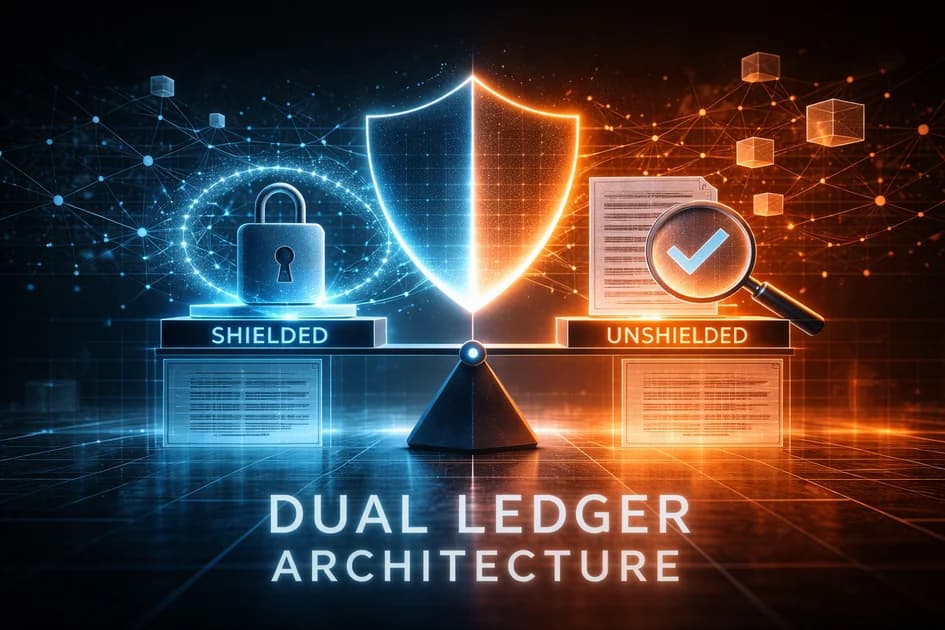
The answer is that Midnight does not rely on a single ledger. It operates with two ledgers running in parallel: a shielded ledger and an unshielded ledger. Together they form the infrastructure that allows applications to choose their position on the privacy spectrum.
The Privacy Spectrum Problem
Most blockchain architectures enforce a binary model.
On Ethereum, everything is transparent. Transactions, balances, and contract interactions are permanently visible on-chain.
On Monero, nearly everything is hidden by default. Transaction participants and amounts are shielded through advanced cryptographic techniques.
Both models solve a problem, but both introduce limitations.
Businesses often need confidential operations while still proving regulatory compliance.
Individuals want private transactions, but sometimes need transparent financial history for lending or audits.
Institutions require verifiable systems without exposing internal financial data.
Midnight approaches this differently. Instead of choosing between transparency or privacy, the protocol introduces a continuum.
Applications decide which data should be public and which should remain private.
The dual ledger architecture makes this flexibility possible.
Shielded and Unshielded Ledgers
Midnight processes two types of transactions on the same network infrastructure.
The unshielded ledger behaves similarly to traditional public blockchains. Transaction details are visible, wallet addresses are transparent, and anyone can inspect balances. This model is useful for governance systems, treasury management, and exchange listings where verifiability is required.
The shielded ledger operates differently. Transaction metadata remains hidden, protected by zero-knowledge cryptography. Observers cannot determine the sender, recipient, or transferred amount.
Validators still confirm that the transaction is valid. They simply verify a cryptographic proof instead of reading the raw data.
The important detail is that both ledgers share the same validator set and consensus mechanism. The difference lies only in the information revealed during transaction verification.
The Token Model: NIGHT and DUST
The privacy architecture becomes clearer when looking at Midnight’s native assets.
The network’s primary utility token is NIGHT Token.
NIGHT operates on the unshielded ledger. Its transactions are fully transparent. Anyone can verify holdings, transfers, and governance participation. This visibility is intentional because consensus and governance require public accountability.
However, NIGHT also performs another function.
Holding NIGHT generates DUST Token.
DUST is not a tradeable asset. Instead, it acts as a private operational resource used to pay for shielded transactions and smart contract execution.
A useful analogy is energy generation.
NIGHT functions like solar panels.
DUST functions like electricity.
As long as a user holds NIGHT, DUST accumulates over time. Transactions spend DUST instead of consuming the underlying governance asset.
This separation provides two benefits.
First, transaction activity remains private because DUST operates on the shielded ledger. Observers cannot easily track usage patterns. Second, users avoid constantly spending their primary token simply to interact with the network.
DUST also decays when disconnected from the NIGHT tokens that generate it. This mechanism prevents hoarding and ensures that DUST functions as a renewable network resource rather than a speculative asset.
Ledger Tokens and Contract Tokens
Beyond the core tokens, Midnight supports two categories of user-created assets.
The distinction reflects the hybrid ledger architecture introduced earlier.
Ledger Tokens
Ledger tokens are managed directly by the protocol. They exist as UTXO-based assets, allowing the network to process transactions in parallel with minimal computational overhead.
Because they operate at the protocol level, ledger tokens offer maximum performance and efficiency.
These tokens can exist in two forms:
Shielded ledger tokens, which enable confidential transfers
Unshielded ledger tokens, which provide full transparency
Shielded ledger tokens resemble private digital cash. Transaction details remain hidden while validators verify correctness through cryptographic proofs.
Unshielded ledger tokens behave more like standard public assets where balances and transfers are visible.
Contract Tokens
Contract tokens are created through Midnight’s Compact smart contract system.
Unlike ledger tokens, they rely on an account-based state model similar to token contracts on Ethereum.
This approach allows developers to implement complex logic such as governance systems, programmable supply schedules, or advanced DeFi mechanisms.
Contract tokens also support shielded and unshielded variants.
A shielded contract token might represent confidential company equity where transfers remain private but voting rights are verifiable. An unshielded contract token might behave like a traditional ERC-20 asset used in transparent decentralized applications.
The Token Matrix
When privacy configuration and token location combine, Midnight produces four possible asset categories.
Shielded ledger tokens provide native privacy with maximum efficiency. They are ideal for confidential payments or business transactions where throughput and privacy both matter.
Unshielded ledger tokens provide high performance while maintaining transparency. Assets used in public treasuries or regulated markets often fall into this category.
Shielded contract tokens enable programmable privacy. Developers can create applications where complex logic executes while sensitive transaction data remains hidden.
Unshielded contract tokens provide full programmability and transparency. These resemble traditional DeFi tokens, governance tokens, or gaming assets.
This matrix allows developers to choose the correct balance between performance, programmability, and privacy.
The Underlying Infrastructure
At the infrastructure level, Midnight builds on the Polkadot SDK architecture.
Core logic compiles into WebAssembly, ensuring deterministic execution across all validator nodes.
The primary component responsible for privacy operations is the pallet-midnight module. This module processes transactions containing cryptographic proofs rather than traditional signature-only verification.
When a shielded transaction enters the network, validators verify its zero-knowledge proof against the current ledger state. If the proof validates, the transaction’s state transition is accepted and committed to the blockchain.
The ledger stores only commitments to the updated state. The underlying private data never becomes visible.
Unshielded transactions follow a simpler path. Validators can inspect the transaction data directly and verify correctness without additional cryptographic steps.
Zswap: Confidential Transaction Mechanics
Midnight uses a transaction scheme known as Zswap to coordinate shielded asset transfers.
Zswap combines concepts from earlier privacy systems such as Zcash and confidential transaction models. It provides several important capabilities.
First, Zswap allows multiple transactions to be merged while maintaining confidentiality. This improves throughput by reducing the number of individual verification operations.
Second, the system supports multiple asset types within the same privacy framework. Different tokens can use the same shielded transaction infrastructure.
Third, Zswap enables atomic swaps between shielded assets. Two parties can exchange tokens in a single transaction while both sides remain confidential.
These properties make Zswap particularly useful for building private decentralized finance applications.
The Market Fit: Rational Privacy
The underlying philosophy behind Midnight is often described as rational privacy.
The protocol does not assume that every interaction must be private. It also does not assume that transparency should be universal.
Instead, it acknowledges that different contexts require different levels of disclosure.
A public treasury requires transparent accounting.
A supply chain contract may require confidential supplier relationships.
A financial transaction may need privacy for the participants but verification for regulators.
Midnight’s architecture allows each application to define that balance explicitly.
Roadmap and Technical Hurdles
The design introduces powerful capabilities, but several challenges remain before widespread adoption becomes likely.
Zero-knowledge proof generation remains computationally expensive compared to standard transaction verification. Improving proof generation performance will be essential for large-scale applications.
Developer tooling must also mature. While the Compact language abstracts many cryptographic details, privacy-preserving smart contracts still introduce new design considerations.
Finally, interoperability with external ecosystems will determine how effectively Midnight integrates with the broader blockchain environment, particularly with its partner chain Cardano.
Bringing It Together
Midnight’s dual ledger architecture transforms privacy from a rigid rule into a configurable property.
The shielded ledger protects confidential data.
The unshielded ledger provides transparent verification.
The token model allows developers to choose the appropriate structure for each application.
Instead of forcing users into absolute transparency or absolute anonymity, Midnight offers something more flexible.
A blockchain system where privacy becomes a programmable feature rather than a fixed constraint.
Discussion
Join the conversation
Connect your wallet to share your thoughts and engage with the community
No comments yet
Connect your wallet to be the first to comment!